
How to Use Kindergarten Readiness Worksheets at Home
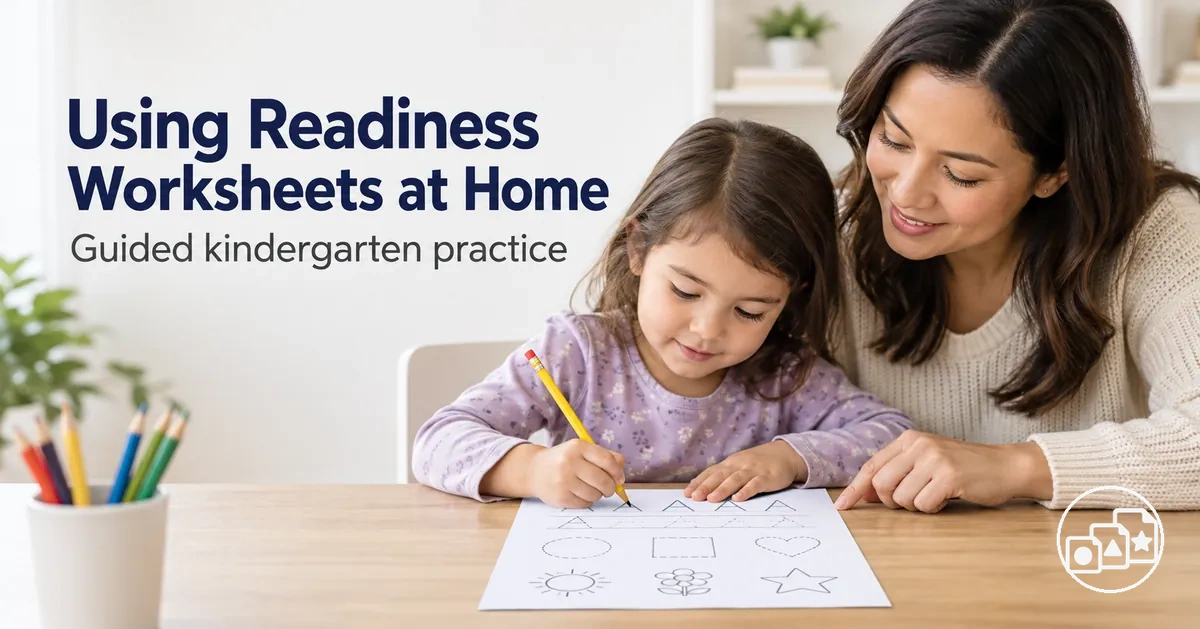
Use kindergarten readiness worksheets at home as brief, targeted reinforcement for one familiar skill at a time, not as the child’s whole readiness program. Model one example, let the child try a manageable amount with the least support they need, stop when productive engagement drops, then reinforce the same skill through play or everyday activity and adjust the next session from repeated observations.
Home worksheet practice cycle
Use this cycle to keep practice focused, manageable and responsive to the child.
- Choose one familiar skillPick a skill the child has already encountered and make it the single practice target.
- Set a manageable taskChoose a small amount of work and decide the stop cue before practice begins.
- Model, then hand overShow one clear example, then return the worksheet so the child can attempt the next item.
- Prompt only as neededPause for an independent attempt; add the lightest cue that helps the child proceed.
- Stop, reinforce, adjustFinish when productive engagement drops, reuse the same skill in play or daily life, then change one justified variable next time.
- If practice is manageable
- Keep the current amount, support and difficulty stable.
- If fatigue appears
- Reduce the amount or end sooner rather than requiring page completion.
- If confusion persists
- Adjust support or review whether the worksheet matches the child’s current skill level.
Table of Contents
Plan a Sustainable Home Worksheet Routine
A sustainable home worksheet routine is a repeatable practice pattern built around one practice goal, a child who is willing to participate, and a manageable opportunity for home practice.
Choose a clear skill focus before deciding when worksheet practice will happen.
The routine is workable when the task can fit into family life without requiring the child or adult to follow a rigid schedule.
Plan frequency and session length according to the child's willingness, attention, skill familiarity, task level, and the adult support available at that time rather than prescribing fixed minutes or daily practice.
A familiar skill can usually be practised with less explanation, while a less familiar or more demanding task may require more support or a smaller amount of work.
Before fixing the routine, also check whether the task reflects appropriate worksheet use before kindergarten for the child.
Set a stop condition in advance, such as ending or changing the activity when the child is no longer willing to engage or needs increasing support to continue.
For example, a family might fit one familiar worksheet task into a calm part of an existing home routine when an adult is available, then stop when the planned task is complete or the child's engagement drops.
Consistency comes from returning to a workable practice pattern when conditions suit the child and family, not from keeping the frequency or session length identical every time.
Before you start
- Practice goal: one readiness goal is clear enough to guide the worksheet choice.
- Timing and skill focus: the routine fits a manageable opportunity when the child is willing to practise a familiar skill.
- Task level and adult support: the worksheet demand matches what the child can attempt with the support currently available.
- Stop condition: the adult knows when to finish or adjust the practice in response to the child's attention, engagement, or need for support.
Keep Worksheet Sessions Short and Regular
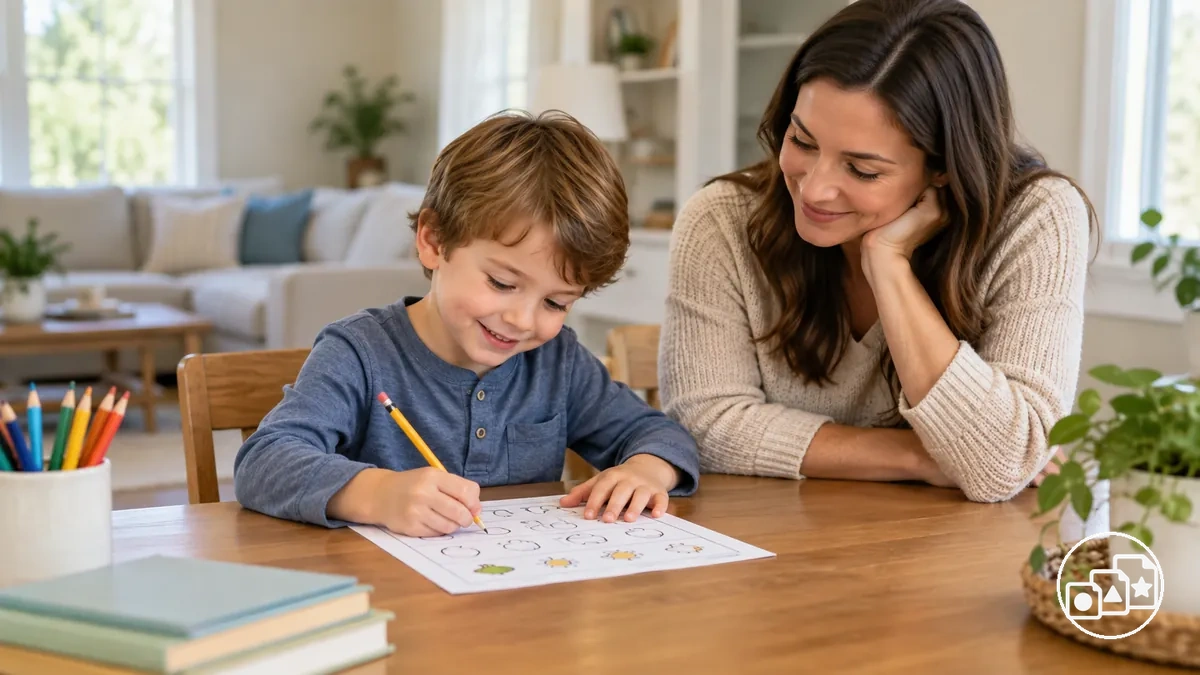
Keep worksheet session length and frequency brief and regular enough to remain manageable for the child, rather than following one universal duration or practice frequency.
Short sessions should fit the child's current attention, comfort, and willingness to continue.
How often and how long to practise may call for adjustment according to the child, the familiarity and difficulty of the task, and the conditions on that day.
Use observable stop cues
- Continue while
- The child remains comfortable, attentive and able to attempt the task without mounting frustration.
- Stop or shorten when
- Attention drops, difficulty continues despite appropriate support, discomfort appears, or the child becomes reluctant to continue.
- Prioritise over page completion
- Accuracy, effort and engagement together, plus whether the practice remains manageable and the child is willing to return.
Choose a Familiar Readiness Skill for Each Session
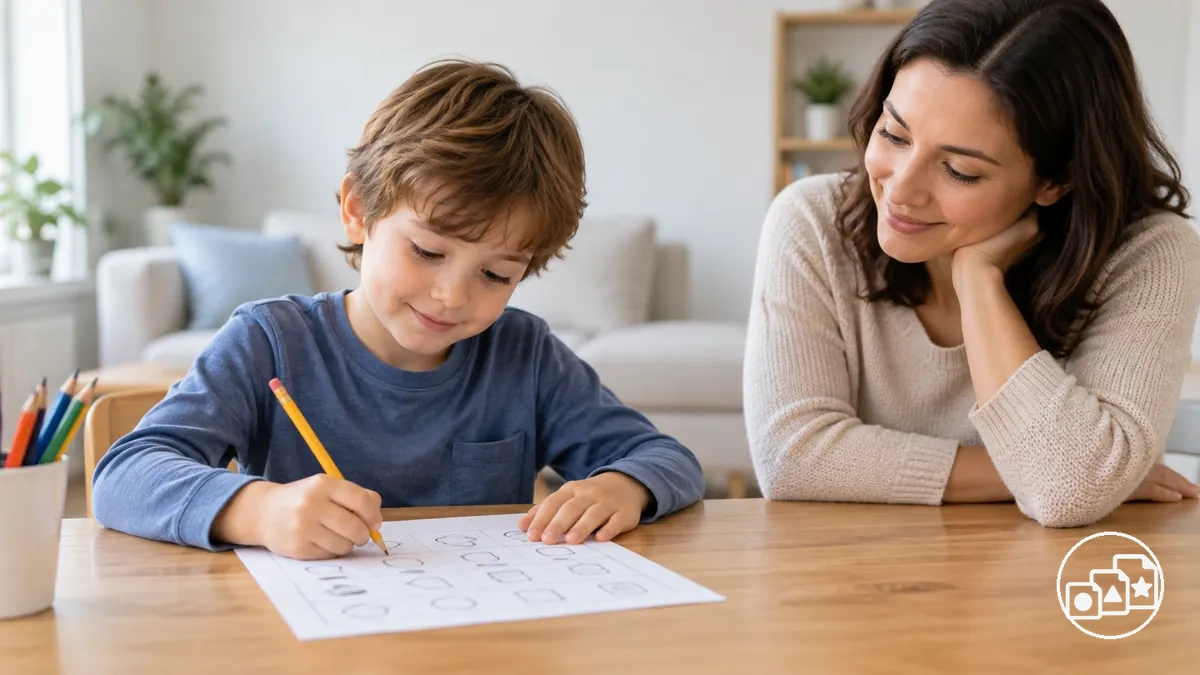
Choose one familiar readiness skill as the practice target for each session so the worksheet provides reinforcement instead of introducing several new demands at once.
A familiar skill is one the child has already encountered and can recognise or begin attempting without the worksheet also having to introduce the underlying concept.
Match the worksheet demand to that familiar skill so the session stays focused on practising the target skill.
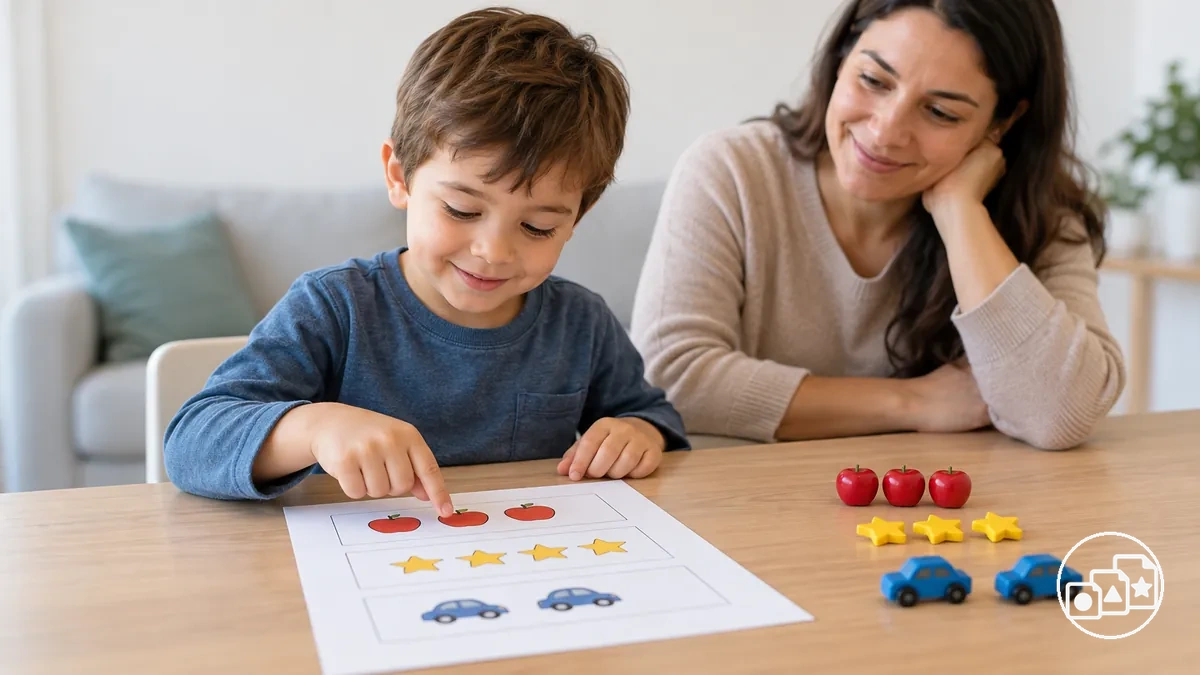
For example, if the child has already practised counting small groups of objects, a worksheet can use that familiar counting skill as the single practice focus rather than combining it with unfamiliar instructions or several new skills.
When choosing among the broader skills to include in readiness practice, select a readiness skill whose prior exposure, worksheet demand, and intended practice outcome align for that child.
Run Each Worksheet Session in a Simple Sequence
Run each worksheet session as a simple sequence: orient the child to the task, model the start, allow an independent attempt, give brief feedback, and finish at a clear stop point.
Keep each stage distinct so the child can follow the session flow without several demands being introduced at once.
Use a prompt only when the child's response indicates that more support is needed.
This ordered routine keeps adult support proportionate to the task by moving from initial guidance toward the child's own attempt.
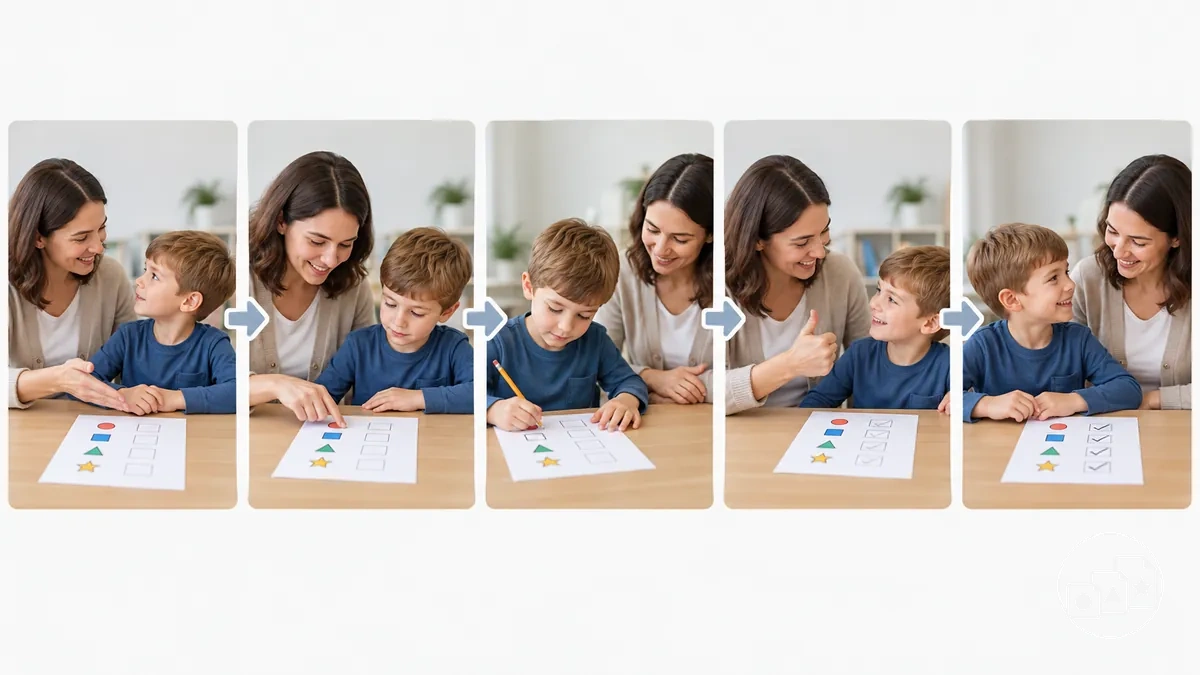
- Orient to the task. Briefly show the child what the worksheet asks them to do so the practice target and first action are clear.
- Model the start. Model one item or example to demonstrate how to begin, then return control of the task to the child.
- Allow an independent attempt. Give the child an opportunity to attempt the task before adding help, using a prompt only if their response shows that support is needed.
- Give brief feedback. Respond to the child's attempt with concise feedback that keeps attention on the current practice task.
- Finish at a clear stop point. End the worksheet session when the planned practice reaches its stop point rather than requiring the child to complete every item.
Introduce the Task With a Simple Example
Introduce the task by stating the task instruction clearly, demonstrating one model item, and then making the handoff to the child for an independent attempt.
Keep the demonstration focused on the same action the child is expected to try.
Check child understanding from their response, and provide further clarification only if the task is still unclear.
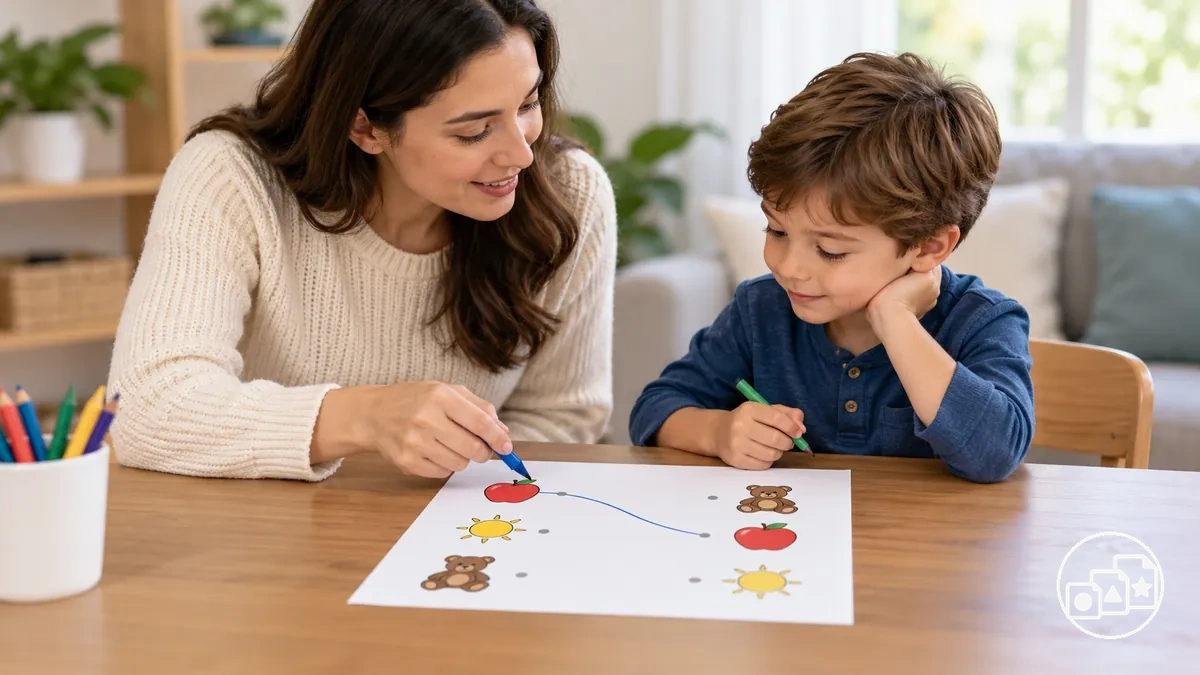
If the instruction is to circle the matching picture, name the task and demonstrate how to circle one matching picture on the model item.
Then stop modelling and hand the worksheet back so the child can try the next item. If the child understands what to do, no further model item is needed before the independent attempt.
Let the Child Try a Small Amount With Minimal Prompting
Prompting ladder
- Independent attemptGive a small amount of the worksheet and pause long enough to see whether the child can begin or continue independently. Brief hesitation alone does not require intervention.
- Light cueIf the child does not proceed, direct attention back to the task without supplying the response.
- More direct supportIf confusion continues, increase prompting gradually and provide only the amount of help needed for the child to proceed.
Adjust support to the observed child response rather than withholding needed help or requiring completion of the whole worksheet.
The goal is to provide enough support for the task while retaining as much independence as the child can manage during the attempt.
Finish With Brief Feedback and a Clear Stop Point
End the session with specific feedback that names the practised skill or acknowledges the child's effort, then state a clear stop point.
Keep the feedback brief and connected to what the child actually did rather than relying on vague praise.
The stop point does not need to be the end of the worksheet; it marks the clear finish of the current practice.
Decide when to stop from the child’s response
Use attention, effort, accuracy, frustration and willingness to continue as observable cues.
Use this when the child remains engaged and productive.
Use this when attention or willingness declines, frustration increases, or productive practice has ended.
Keep Worksheet Practice Engaging With Hands-On Learning
Keep hands-on learning connected to the same target skill as the worksheet prompt rather than replacing the practice with unrelated fun.
The hands-on activity can change how the child responds through movement, touch, speech, drawing, or play while preserving the same learning objective.
This makes the activity an active practice extension of the worksheet task rather than a separate learning task.
Map the worksheet prompt to its target skill first, then choose an active response that lets the child practise that skill in another mode.
For example, a counting prompt can extend to counting manipulatives, a shape prompt to finding and naming shapes among household objects, or a pre-writing line task to forming the same type of line with playdough.
This skill-matched approach can help balance worksheets with hands-on learning without turning the activity into an unrelated diversion.
- Counting worksheet → manipulatives: Count a small set of counters or household objects to practise the same counting objective through tactile active practice.
- Shape worksheet → movement: After identifying a target shape on the worksheet, find or point to examples of that shape around the room to continue practising shape recognition.
- Pre-writing worksheet → playdough: Form the same line or simple shape with playdough so the hands-on extension preserves the worksheet's target skill.
- Picture or sound worksheet → stamps or drawing: Use a stamp or simple drawing to represent an item that matches the same picture or sound category being practised.
The purpose is integration: the hands-on activity should preserve the same learning objective rather than becoming an unrelated diversion.
An everyday activity or hands-on extension belongs in the session when it gives the child another opportunity to practise the same learning objective; an activity that changes the objective belongs to a different learning task.
Turn Selected Worksheet Prompts Into Active Practice
Transform a worksheet prompt into active practice by identifying its target skill, preserving that skill, and changing only the response mode to an active action.
The child should still practise the same learning objective even though the response moves beyond paper-only work.
The method is: identify the skill → change the response mode → check that the skill stayed the same.
A valid transformation changes how the child responds while keeping the target skill and expected practice outcome aligned with the original worksheet prompt.
The active action can use manipulatives, movement, or tactile materials when they fit the task; if the activity introduces a different skill or makes entertainment the main objective, it has drifted from the original prompt.
The following sequence preserves the target skill while changing only how the child responds.
- Identify the target skill. Name what the worksheet prompt actually asks the child to practise. Check that the identified skill describes what the child is practising rather than the paper action used to respond.
- Change the response mode. Convert the paper response into an active action that still requires the child to use the target skill. Check that the hands-on version has not introduced a different learning objective.
- Check the practice outcome. Observe whether the active response still demonstrates practice of the same target skill. For example, transform a worksheet prompt that asks a child to count pictured objects into counting real objects: the response mode changes from answering on paper to handling and counting objects, while the target skill and observable practice outcome remain counting.
Reinforce the Same Skill Through Play or Everyday Activities
Reinforce the same skill after worksheet practice by reusing it during play or an everyday activity in a natural context.
Keep the target skill unchanged while giving the child another practice opportunity through reading, conversation, movement, or a household routine.
The child's active response should still involve the skill already practised rather than introducing an unrelated learning objective.
Repeated exposure can provide further opportunities to notice, practise, and apply the same skill across familiar situations, but repetition alone does not guarantee improvement.
Choose a context in which the child's active response clearly connects to the target skill, and adjust the practice opportunity according to how the child responds in that situation.
The examples below show same-skill reinforcement through ordinary routines and play without changing the learning objective.
- Setting the table: Ask the child to count plates, cups, or other items as they are placed on the table, reinforcing a counting skill already practised on a worksheet.
- Reading together: Invite the child to notice a familiar target letter on a page, reinforcing recognition of the same letter practised during worksheet work.
- Drawing during play: Let the child draw lines or simple shapes that match those already practised, reinforcing the same pre-writing or shape skill through an active response.
- Movement in a daily routine: If the worksheet practised a simple positional concept, invite the child to demonstrate that same concept through an appropriate movement, reinforcing the original target skill in a natural context.
Adjust the Next Session Based on the Child's Response
Adjust the next session according to the child's observed response in the completed session, changing only what that response justifies where practical.
Treat the current state as a baseline for deciding whether task amount, support, or difficulty needs adjustment rather than repeating the same setup automatically.
Change one variable when one change is enough to test, then compare the child’s response in the next session.
What to change next
- Practice was manageable
- Keep the current task amount, support and difficulty stable so the next session gives you a useful comparison.
- Fatigue appeared
- Reduce the task amount or finish earlier before changing several other variables.
- Confusion persisted
- Adjust the level of support first; if confusion continues—or the work is repeatedly unusually easy—review whether the worksheet matches the child’s current skill level.
- Disengagement recurs
- Change one plausible variable in the session setup, then compare the child’s response before making another change.
A single imperfect attempt does not establish why a child found the practice easy, confusing, tiring, or difficult to engage with, so use a repeated pattern to guide interpretation where possible.
Test the selected adjustment in the next session and compare the observed response with the previous current state before deciding whether another change is needed.
Common Mistakes When Using Readiness Worksheets at Home
Common home worksheet practice mistakes are routine choices that can make practice less useful or manageable, such as excessive session length, poor task match, overprompting, continuing despite fatigue, or omitting active reinforcement.
Each mistake has a different likely consequence, so the corrective direction should address the specific routine error rather than changing the whole practice setup.
Observable recognition cues can help identify which adjustment is relevant.
A correctable practice mistake is linked to a specific part of the routine and can be checked after that part is adjusted.
Repeated refusal, rushing, or focus problems that continue after routine mistakes are corrected belong to a broader pattern rather than being explained by one session choice alone.
In that case, it is more appropriate to troubleshoot worksheet engagement separately instead of assuming a single routine adjustment explains the pattern.
The table connects each common mistake with its likely consequence, recognition cue, and corrective direction.
| Mistake | Likely consequence | Recognition cue | Corrective direction |
|---|---|---|---|
| Letting session length extend beyond productive practice | Fatigue may contribute to declining attention or willingness to continue. | The child becomes tired or less engaged as the session continues but was able to participate earlier. | Shorten the next session and use the child's response as a stop cue rather than requiring completion of the worksheet. |
| Choosing an unfamiliar or mismatched task | A poor task match may produce confusion that makes the intended skill difficult to practise. | The child repeatedly cannot begin or continue the task even after the instruction and a simple example are clear. | Review the task level and choose work that better matches the skill the child is ready to practise. |
| Overprompting during the child's attempt | Frequent adult intervention can reduce the opportunity for an independent response. | The adult supplies cues or directions before the child has had enough wait time to attempt the item. | Reduce support initially, allow an independent attempt, and add a prompt only when the child's response indicates that help is needed. |
| Requiring completion despite fatigue | Continuing after productive practice has ended may make the remaining work less manageable. | The child shows clear fatigue or declining willingness to continue, but the session continues solely to finish the page. | Use a clear stop point and end the session without making worksheet completion the default requirement. |
| Using worksheets without active reinforcement | The same skill receives no additional practice opportunity through another response mode or everyday context. | Practice ends with the worksheet even when a simple hands-on extension, play activity, or daily routine could reuse the same skill. | Add active reinforcement that preserves the same target skill, such as practising it with objects, movement, play, or an everyday activity. |