
Matching Kindergarten Readiness Worksheet Difficulty to a Child's Skill Level
Choose kindergarten readiness worksheet difficulty from the child’s demonstrated skill on the target task and the support needed to perform it, not from age or grade alone. Keep the target skill constant, adjust one task demand at a time, and recheck repeated performance: hold a manageable challenge, reduce or scaffold persistent breakdown, and increase one demand when independent success is consistently stable.
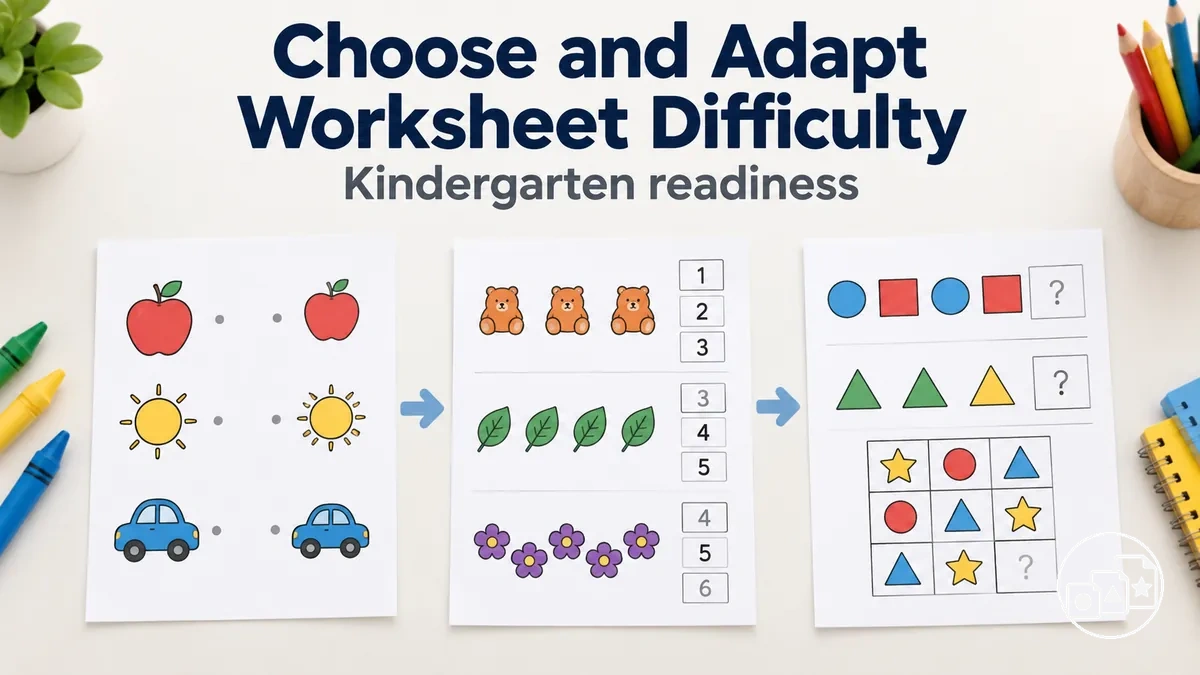
Worksheet difficulty decision guide
Match the next adjustment to the child’s repeated task-specific pattern. Use performance and support together; a single fast, difficult, or emotional attempt is not enough to classify the worksheet.
- Persistent breakdown or high support
- Reduce one blocking demand, or add the least temporary scaffold when the worksheet is only slightly too difficult. Keep the target skill unchanged, then recheck.
- Successful with manageable effort
- Hold the current difficulty. Continue observing accuracy, independence, prompting, and consistency; fade support as repeated success becomes more independent.
- Stable independent success with little challenge
- Increase one demand modestly while preserving the same target skill. Recheck before changing another variable.
Decision rule: change the worksheet demand, not the learning objective, and verify the effect across repeated attempts before making the next adjustment.
Worksheet difficulty is an adjustable relationship between current skill, task demand, support, and independence. The same child may need different levels for different skills or task formats, and familiarity, instruction clarity, response requirements, and available assistance can change observed performance.
Table of Contents
Choose a Starting Level From the Child's Current Skill
Choose the starting worksheet level from the child’s demonstrated performance on the specific target skill, not from age or grade alone.
Consider successful performance and the support needed together, because no single signal provides enough information to select a workable challenge.
Use a short sample to compare task understanding, accuracy, prompting, persistence across the sample, and independence.
These criteria separate evidence that the child can perform the target skill from the support still needed to perform it, while broader assessment may be useful when you need to identify readiness skill gaps.
The image compares two worksheet versions with the same target skill but different task demands, showing how the starting challenge can change without changing what the child is practising.

- Task understanding: If the child understands what the worksheet asks without repeated explanation, the current format can support the starting level; if repeated explanation is needed, begin with a simpler presentation of the same target skill.
- Accuracy: If the child demonstrates the target skill accurately across the short sample, the current demand can remain part of the initial level; if errors repeatedly prevent the skill from being demonstrated, reduce the starting task demand.
- Prompting: If the child needs only occasional prompting, the current level may provide a workable challenge; if repeated prompting is needed to continue or respond, begin with a level requiring less support.
- Short-sample persistence: If the child can sustain an attempt across the short sample, the amount of work may be workable; if the child cannot sustain the sample even with reasonable support, begin with less task demand or a shorter sample.
- Independence: If the child can perform the target skill with limited assistance, the starting level can preserve more challenge; if continuous assistance is required, begin with a level that allows greater independence.
For example, two children practising the same letter-recognition skill may need different starting worksheet levels if one identifies the letters with limited prompting while the other needs repeated cues to respond.
The starting level is provisional, so choose the level that provides a workable challenge for current performance and adjust it as demonstrated performance and support needs change.
Match the Worksheet to the Skill Being Practised
Judge worksheet difficulty against the target skill being practised, not against the worksheet as a whole.
A secondary demand can increase apparent difficulty even when the target skill itself is appropriately matched.
- Target skill
- The intended ability being practised. Keep this constant when you are adjusting worksheet difficulty.
- Instructions and comprehension
- Longer or less clear directions can add reading or task-understanding demand.
- Motor response
- Writing, tracing, or cutting can add a motor demand that is separate from the target skill.
- Visual scanning
- Finding the relevant item among choices adds a search requirement.
- Step count
- A multi-step task adds process demand because several requirements must be completed while the child demonstrates the same skill.
The annotated example separates the target skill from these secondary demands so the source of apparent difficulty is easier to interpret.
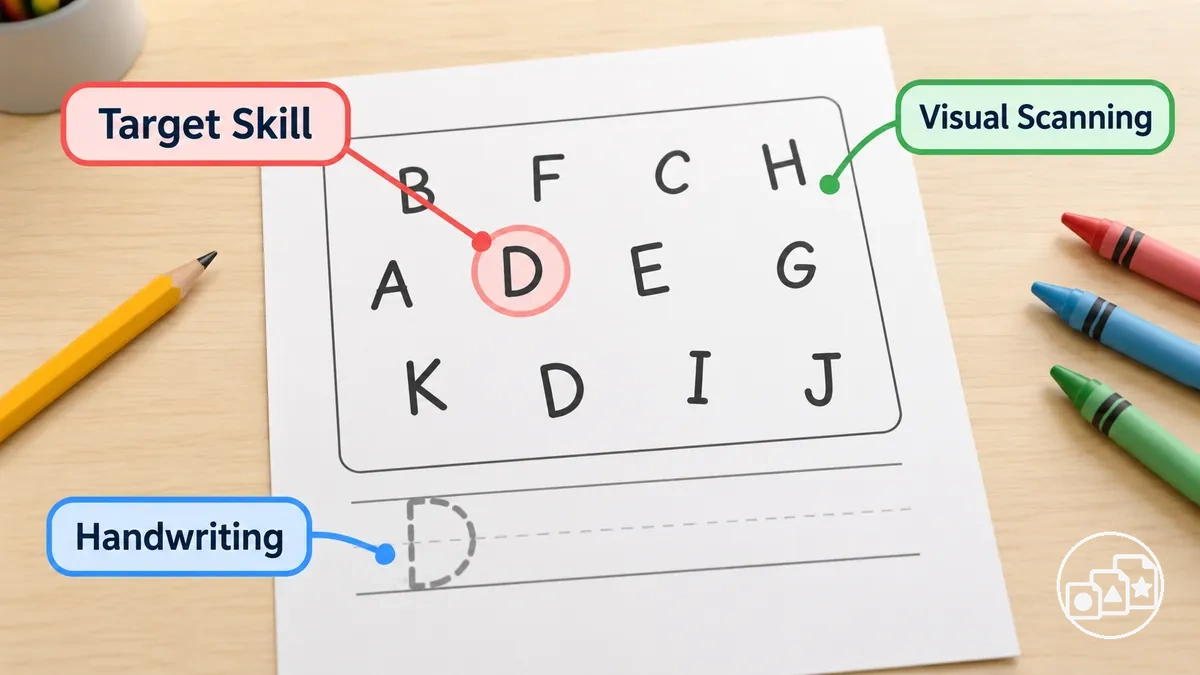
For example, a worksheet may target letter recognition but require the child to write or trace each answer; in that case, handwriting and pencil control associated with pre-writing readiness practice add a secondary demand that can make the worksheet appear harder.
Keeping the target skill identifiable helps distinguish difficulty with letter recognition from difficulty created by the response requirement without treating either response as proof of a broader skill gap.
Start Where the Child Can Work With Partial Independence
A workable starting level allows partial independence: the child can make a meaningful attempt with limited support without an adult completing the task or the work being effortless.
The aim is a workable challenge where the child can attempt the target skill and the support level can be adjusted as needed.
Use support intensity as a task-fit signal: a workable starting level lets the child make a meaningful attempt with limited support, while repeated need for substantial prompting suggests reducing the demand or adding targeted support.
The image represents degrees of assistance while the child works on the same target skill, from an independent attempt through increasing adult support.
Because the meaning of a cue or prompt can depend on the task and the child’s familiarity with it, use the overall support level rather than a single response to interpret starting-level fit.
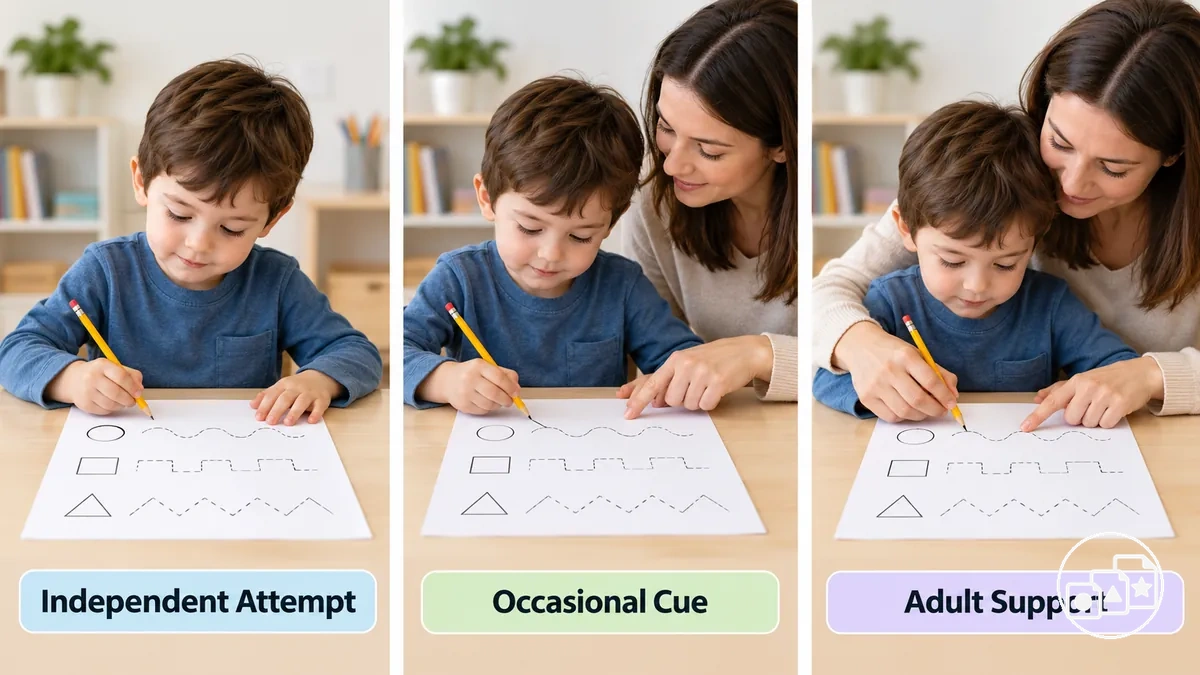
- Independent attempt: The child starts and responds without adult help, suggesting the current task can support independent performance.
- Occasional cue: The child attempts the task independently but responds to a light cue when needed, which can still indicate a workable challenge.
- Repeated prompt: The child requires repeated prompts to continue or respond, suggesting the current task may demand more support than is suitable for the starting level.
- Full assistance: The child requires an adult to guide or complete much of the response, suggesting the task fit should be adjusted toward a level that allows greater independence.
Check Whether the Worksheet Is Too Hard or Too Easy
Judge worksheet-task fit from a pattern across performance, independence, prompting, and repeated attempts rather than from one behaviour.
A recurring error pattern combined with increasing support needs may suggest that the worksheet is too hard, while stable independent success with little prompting may suggest that it is too easy.
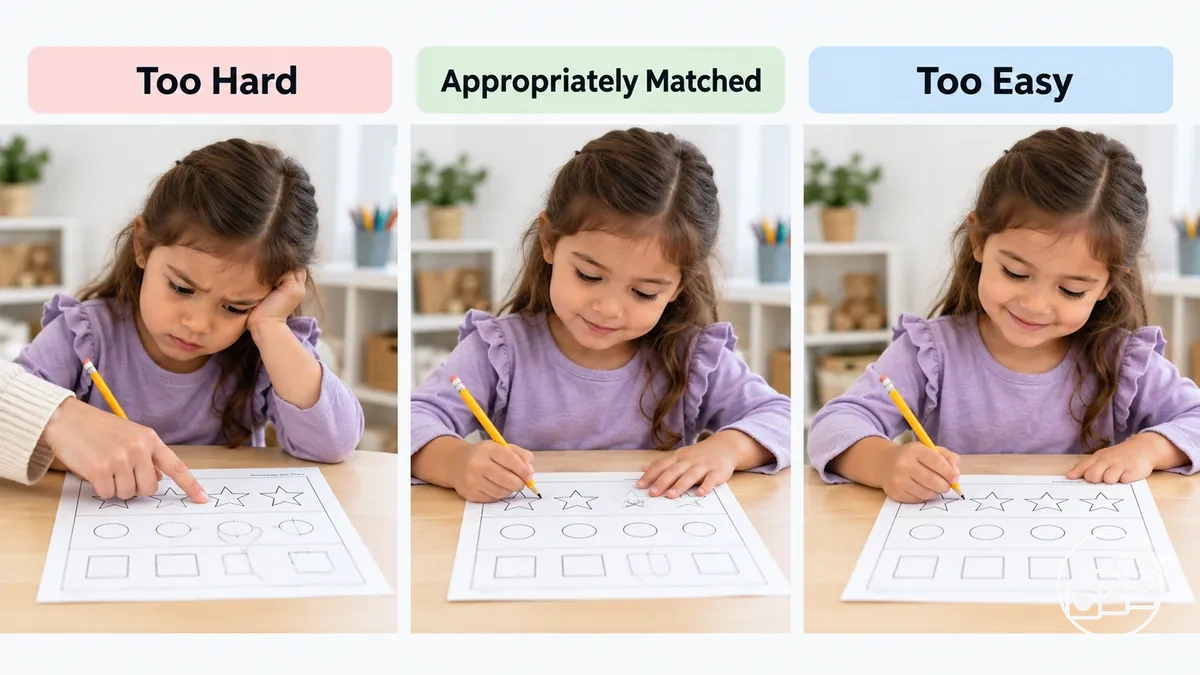
There are three useful interpretations: too hard when task demand repeatedly exceeds what the child can manage with reasonable support, too easy when success is consistently stable with little support or challenge, and appropriately matched when the child can continue with manageable errors and limited support.
The image gives a visual orientation to these three task-fit states while keeping the worksheet context comparable.
These states are interpretations of observable task-specific patterns, not diagnoses of the child.
| Observed pattern | Possible interpretation | What to check | Next difficulty decision |
|---|---|---|---|
| Persistent breakdown across repeated attempts with frequent prompting or high support | The worksheet may be too hard because current task demand exceeds what the child can manage with the available support. | Check whether the same error pattern continues and whether the child can complete the target skill with greater independence when task demand is reduced. | Reduce difficulty while keeping the target skill identifiable, then observe whether independence and consistency improve. |
| Stable success across repeated attempts with little prompting and consistent independence | The worksheet may be too easy because the task provides insufficient challenge for the child's current performance. | Check whether success remains stable without extra cues and whether the child completes the task consistently across comparable items. | Increase task demand while keeping the target skill constant, then check whether the new level remains manageable. |
| Generally successful performance with manageable errors and limited prompting | The worksheet may be appropriately matched because the child can engage with the challenge without persistent breakdown or effortless completion. | Check whether the child maintains partial independence and a similar performance pattern across repeated attempts. | Continue at the current difficulty while monitoring whether support needs or performance patterns change. |
Refusal, inattention, frustration, or speed alone does not establish that a worksheet is too hard or too easy, because difficulty mismatch is only one possible reason why children struggle with readiness worksheets.
Make a task-demand adjustment only when the broader pattern of errors, prompting, independence, and repeated attempts supports that interpretation rather than treating one session or behaviour as confirmation.
Signs the Worksheet Is Too Hard
A worksheet may be too hard when repeated breakdown on the target task persists despite clear instruction and reasonable support.
Look for a repeated task-specific pattern rather than treating one difficult attempt or emotional reaction as evidence of excessive task demand.
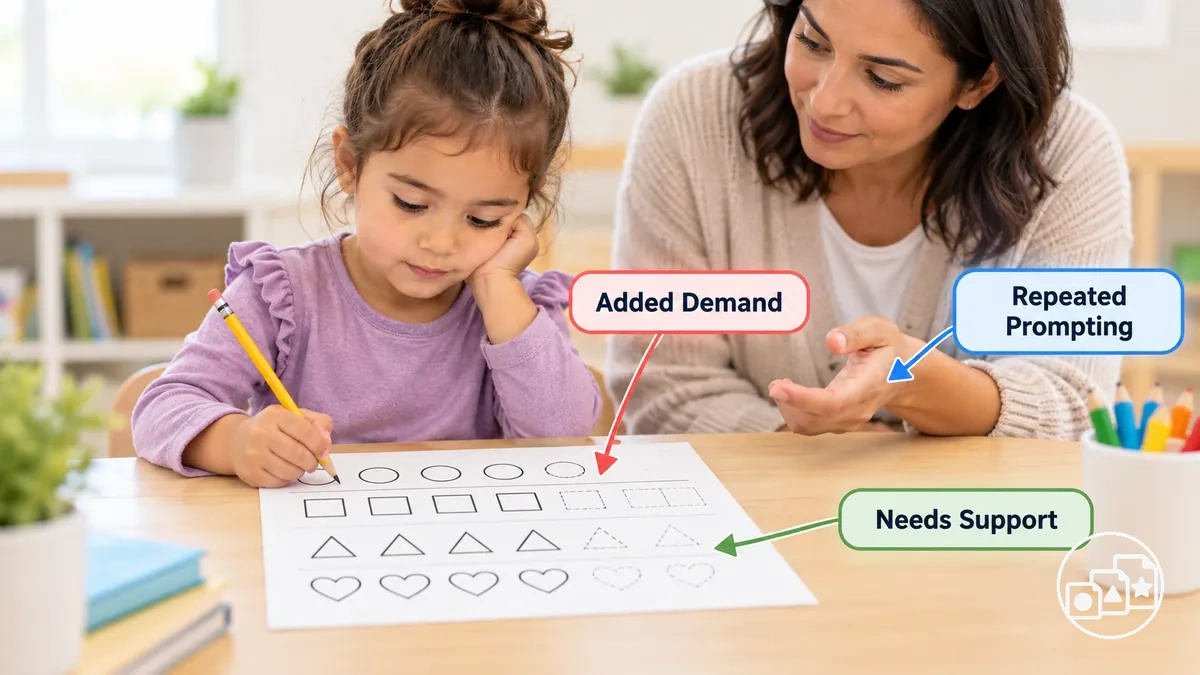
The image illustrates how an added demand can coincide with a higher support need, while the signals below group recurring patterns from starting the task through performance and prompting.
Difficulty beginning after clear instruction, persistent target-skill errors, repeated prompting, or breakdown when a specific demand is added may indicate that the current task demand is too high.
When these patterns persist, reduce demand or add a temporary scaffold, then retry the task and observe whether the child can work with greater independence.
- Difficulty starting: If the child repeatedly cannot begin after clear instruction and reasonable support, the starting task demand may be excessive.
- Target-skill errors: If target-skill errors persist across the task despite support, the current challenge may exceed what the child can manage at that level.
- Added-demand breakdown: If performance breaks down when a specific demand is added, that added demand may be making the worksheet too hard.
- Repeated prompting: If the child requires repeated prompting to continue or respond, the high support need may suggest that task demand should be reduced or temporarily scaffolded.
Signs the Worksheet Is Too Easy
A worksheet may be too easy when the child shows stable success and independent accuracy across similar items with a low support need and little remaining challenge.
Repeated success and consistency are stronger signals of insufficient challenge than one quick or successful attempt.
Use the current task demand to distinguish stable independent performance from mere speed: quick completion without consistent accuracy or independence does not by itself justify raising the level.
The criteria below separate stable success from a single fast or successful attempt by focusing on independent accuracy, repeated consistency, and low support need.
When that pattern remains stable, raise difficulty modestly by increasing one demand, then observe and recheck whether independent performance remains consistent.
- Independent accuracy: The child performs the target skill accurately with little assistance, suggesting the current demand may provide insufficient challenge.
- Repeated consistency: Similar items produce repeated success rather than an isolated successful response, strengthening the interpretation that the current level may be too easy.
- Low support need: The child requires little support while maintaining independent performance, which can justify a modest increase in one task demand when the pattern remains stable.
Signs the Challenge Is Appropriately Matched
An appropriately matched worksheet provides a manageable challenge: the child can make successful attempts with meaningful effort and limited support.
The criteria below treat appropriate challenge as a pattern across attempts rather than a score, combining enough success to continue with enough challenge to require attention or limited support.
- Successful attempts: The child can demonstrate the target skill successfully while the task still requires attention and effort.
- Manageable errors: Errors remain manageable without causing persistent breakdown, and the child can continue after correction.
- Partial independence: The child completes meaningful parts of the task independently rather than relying on continuous assistance.
- Small cue: When support is needed, the child responds to a small cue and can resume the task without escalating assistance.
- Continuation after correction: The child can continue after correction, supporting the interpretation that the current challenge remains manageable rather than requiring error-free performance.
Taken together, manageable errors, partial independence, responsiveness to a small cue, and the ability to continue after correction can justify holding the current level when successful attempts remain consistent.
Appropriate challenge does not require a fixed error rate or visible struggle.
Task fit remains skill-specific, so the same child may need a different suitable level for another readiness skill.
Adapt Worksheet Difficulty Without Changing the Target Skill
Adapt worksheet difficulty by changing the task demand while preserving the target skill being taught or practised.
Changing the target skill creates a different learning objective rather than a difficulty adjustment to the same task.
Adjustable difficulty levers include the number of items, response choices, instruction length, visual complexity, step count, motor output, cueing, and problem complexity.
Each task feature can be adjusted independently, so not every lever needs to change at the same time.
Changing one lever at a time makes it easier to observe how that specific change affects the task while the target skill remains constant.
The table maps each adjustable worksheet feature to a lower-demand version, a higher-demand version, and what remains unchanged rather than ranking children.
| Task feature | Lower-demand version | Higher-demand version | What stays the same |
|---|---|---|---|
| Number of items | Fewer items practising the target skill | More items practising the target skill | The target skill |
| Response choices | Fewer choices to consider | More choices to consider | The target skill and required type of decision |
| Instruction length | Shorter, simpler instructions for the same task | Longer instructions with more information to process | The target skill |
| Visual complexity | Fewer competing visual elements | More visual elements to scan or distinguish | The target skill |
| Step count | Fewer steps before completing the response | More steps required to complete the response | The target skill |
| Motor output | Less writing, tracing, or other motor output | More writing, tracing, or other motor output | The target skill being demonstrated |
| Cueing | More task-relevant cues | Fewer task-relevant cues | The target skill |
| Problem complexity | A simpler application of the target skill | A more complex application of the target skill | The underlying target skill |
For example, if the target skill is letter recognition, a lower-demand version might present fewer response choices while a higher-demand version presents more choices; both still require the child to identify the target letter.
The response choices change the worksheet demand, while the learning objective remains unchanged.
Reduce Task Demands When the Current Level Is Too Difficult
Reduce demand by changing the specific blocking demand while keeping the target skill intact, rather than simplifying every part of the worksheet at once.
Adjusting one source of task load at a time makes it easier to observe whether independence increases or the error pattern changes without changing the learning objective.
- Quantity: Use fewer items or fewer choices when the amount of work or the number of simultaneous options is the blocking demand. If this reduction improves independence or reduces target-skill errors, the quantity of work or choices may have been contributing to the mismatch.
- Presentation and instructions: Use shorter directions or reduce unnecessary visual clutter while preserving the same target response. Observe whether the child can begin and continue with greater independence and whether the error pattern changes when less information must be processed at once.
- Response and process demand: Use a simpler response requirement or present one step at a time when motor output or step count is the blocking demand. Observe whether the child can demonstrate the target skill more independently with fewer errors while the intended response remains recognisable.
For example, if letter recognition is the target skill and several response choices appear to be the blocking demand, reduce the number of choices while still asking the child to identify the target letter.
Preserve that target response while observing the effect before changing another demand, because changing several demands together makes it harder to identify which adjustment affected independence or the error pattern.
Increase One Difficulty Demand at a Time
Increase one difficulty variable only after performance at the current level provides a stable enough baseline to interpret the effect of a change.
Keep the target skill constant and make a modest increase to one demand rather than increasing several demands together.
The sequence isolates one changed variable so you can observe performance and the support needed before making another adjustment.
- Establish the baseline: Confirm the child's current performance and support needed while the target skill and existing worksheet demands remain at the current level.
- Choose one variable: Select one difficulty demand to adjust rather than changing several features at the same time; more items do not automatically create a more useful challenge.
- Make a modest increase: Increase only the selected variable while preserving the target skill and leaving the other task demands as consistent as practical.
- Observe performance and support: Compare performance and the support needed after the change with the baseline so the effect of the changed variable is easier to interpret.
- Keep or reverse the change: Keep the increase if performance remains workable with manageable support, or reverse or hold the change if the new demand disrupts performance or substantially increases the support needed. Verify the result before you adjust another variable.
Scaffold a Worksheet That Is Slightly Too Difficult
Scaffold a worksheet when it is slightly beyond the child's current independent performance and a specific blocking demand can be supported temporarily.
The temporary support should make the same target skill workable with limited support rather than replace the child’s response; if persistent breakdown continues despite targeted support, reduce the task demand instead.
- Identify the blocking demand. Decide which part of the worksheet is preventing a workable attempt.
- Add the least support that helps. Use one targeted aid such as modelling, a visual cue, a prompt, task chunking, or a guided attempt.
- Observe the response. Check whether the child can participate more independently while the target skill stays the same.
- Fade or revise. Fade support when performance becomes workable; if participation or independence does not improve, adjust the support or reduce the task demand.
For example, if a child can identify the target letters but has difficulty starting a multi-part worksheet, the adult might first use task chunking and a guided attempt for the opening part, then fade support as the child continues.
The objective remains the same target skill before and after scaffolding; temporary support changes access to the task rather than permanently lowering the learning target.
Use Modelling, Visual Cues, and Prompts to Support the Task
Choose the support that matches the part of the worksheet blocking progress while leaving the child responsible for the response. Use modelling when the required action is unclear, a visual cue when relevant information or sequence needs to be more visible, and a verbal, gestural, or positional prompt when attention or action needs a cue; fade the support as the child can continue with less assistance.
- Modelling: Demonstrate the required action or show a first example when the child does not yet understand how to begin the worksheet task. Reduce the demonstration once the child can perform the action without another model.
- Visual cue: Make a relevant task instruction, location, or sequence more visible when the child needs help identifying what to attend to or what comes next. Fade or remove the visual cue when the child can follow the worksheet information independently.
- Prompt: Use targeted assistance such as a verbal prompt, gestural prompt, or positional prompt when the child needs a cue to continue or direct attention to the relevant part of the task. Reduce the prompt when the child can produce the independent response with less assistance.
Reduce Support as the Child Becomes More Independent
Reduce support when the child shows repeated success with less assistance across more than one attempt, rather than after one successful item.
- Move to a lighter cue only after repeated success with less assistance, while keeping the target skill unchanged.
- Recheck after each reduction. Confirm that successful performance and independence remain workable before fading support again.
- Continue or step back. Move toward an independent attempt when performance holds; if performance breaks down or assistance needs increase, return to the previous support level or adjust the cue.
Recheck the Difficulty After Each Adjustment
After any adjustment, recheck whether the changed demand improved task fit rather than assuming the change worked.
Compare the child's response with the prior baseline while keeping the target skill and the specific variable that was adjusted explicit.
The verification checklist organises the observation needed before another adjustment is made and should be applied across several items or repeated attempts.
- Target-skill accuracy: Observe whether performance on the target skill becomes more accurate, less accurate, or remains similar after the adjustment.
- Independence: Check whether the child can perform more of the task independently under the changed demand.
- Prompting: Compare the amount of prompting needed before and after the adjustment, noting whether support needs decrease, increase, or remain similar.
- Consistency: Check whether the observed performance pattern remains similar across several items or repeated attempts rather than relying on one response.
- Changed demand: Verify whether the adjusted demand still appears to limit performance or whether the observation suggests that another task demand is contributing to the mismatch.
Interpret the adjustment cautiously because one item or one unusually good or difficult attempt does not establish a stable change in task fit.
If the observation pattern remains consistent across repeated attempts, use it to decide whether to hold the current difficulty, increase one demand, or reduce the relevant demand before rechecking again.
Hold, Increase, or Reduce the Level Based on Performance and Support Needed
Hold the current level when performance shows stable success with appropriate challenge and the child works with independence.
Increase one demand when the current challenge is consistently manageable with limited support, and reduce demand or add temporary support when task-specific breakdown or substantial prompting persists.
Base the difficulty decision on both performance quality and the support needed rather than on accuracy alone.
These decisions do not require a universal cutoff because the useful interpretation depends on the verified performance-and-support pattern for that task.
- Hold: Keep the level when stable success is combined with appropriate challenge and the child maintains independence with manageable support.
- Increase one demand: Raise one task demand when performance is consistently manageable with limited support and independence is stable enough to observe the effect of the change.
- Reduce or support: Lower the relevant demand or add temporary support when persistent task-specific breakdown continues or the support needed remains high enough to interfere with independent performance of the target skill.
The same child may need different difficulty decisions across readiness skills or worksheet formats because performance and support needed can be skill-specific.
A child might hold the current level for one target skill while increasing one demand for another or reducing demand where a different task requirement remains the blocker.
After choosing the appropriate level, apply that decision when you use readiness worksheets at home, while continuing to observe whether the selected challenge remains workable as performance changes.