Kindergarten Readiness Worksheets and Hands-On Learning: How the Approaches Compare
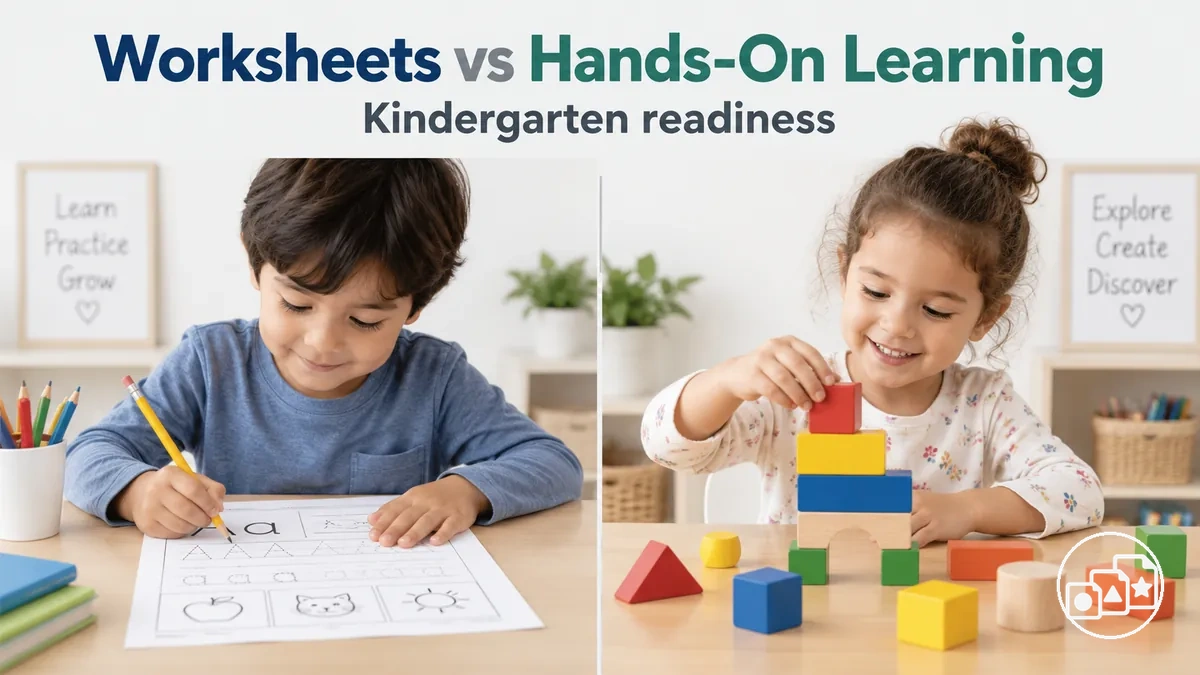
Neither kindergarten readiness worksheets nor hands-on learning is universally better; fit depends on the learning goal, the response the child must produce, and task readiness. Use worksheet practice for clear symbolic or repeated paper responses, hands-on activity for manipulation, exploration or contextual application, and combined use when the same skill benefits from both concrete experience and recording or reapplication.
Match the activity to how the skill must be shown
Start with the learning goal, then choose the format that makes the target performance visible without letting the response demands overshadow the skill itself.
Worksheet practice
Best fit when
The child needs a brief, explicit symbolic response or repeated paper-based practice.
Useful evidence
Recorded answers or visible work that can be reviewed across items or attempts.
Watch for
Writing, marking, tracing or sustained-attention demands becoming harder than the target skill.
Hands-on activity
Best fit when
Handling, arranging, testing, sequencing, speaking or contextual action is part of demonstrating the skill.
Useful evidence
Actions, choices, adjustments and strategies that can be observed during the task.
Watch for
Movement or materials becoming activity for its own sake rather than serving the learning goal.
Combined use
Best fit when
The same learning goal benefits from concrete experience plus symbolic recording, retrieval or later reapplication.
Useful pattern
Explore or manipulate, record or repeat, then apply the same idea in another relevant context.
Watch for
Keep each format tied to the same target skill; the sequence can change with readiness and task demand.
Decision rule: if the response format makes the target skill harder to see, adjust the format or support before interpreting the child's performance.
Task readiness means the child can understand the instructions and meet the activity's response demands without those demands obscuring the target skill; task design and adult support can shift that fit.
Kindergarten readiness worksheets usually organise practice through paper-and-pencil tasks, repetition, and visible responses within a defined format, while hands-on learning usually uses manipulation, exploration, or active application.
Play-based learning can overlap with hands-on learning when exploration and child choice are involved, but the terms are not interchangeable; hands-on tasks can also be adult-guided and goal-directed.
The useful comparison is therefore how each format functions under a particular learning goal, level of task readiness, and task design.
Table of Contents⌄
How Worksheets and Hands-On Learning Differ
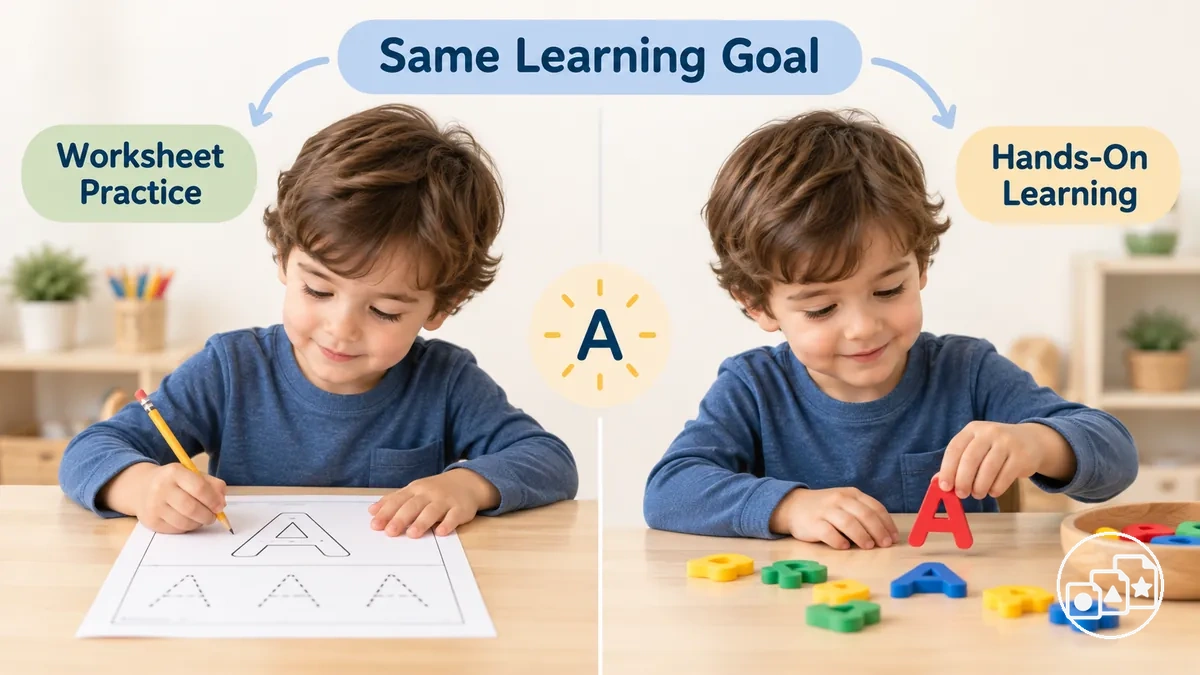
Worksheets and hands-on learning can address the same learning goal while organising practice in different ways.
Their main comparison dimensions are task structure, child participation, response format, feedback, repetition, and application.
Comparing these dimensions consistently shows how the learning experience changes without assuming that either approach is inherently superior.
Worksheet-based practice tends to make instructions and the response format more explicit, often using repeated paper-based responses that adults can review.
The broader role of kindergarten readiness worksheets includes structured practice, while hands-on learning often allows manipulation, observation, and adjustment during the task.
These differences can change how child participation, feedback, repetition, and application occur while the learning goal remains the same.
Worksheet-based tasks usually make the response format more explicit, while hands-on tasks often allow more manipulation or contextual action, but both vary by design.
A worksheet can include choice and adult interaction, while a hands-on activity can follow structured instructions, so task design can make either format more or less structured.
Task Structure and Child Participation
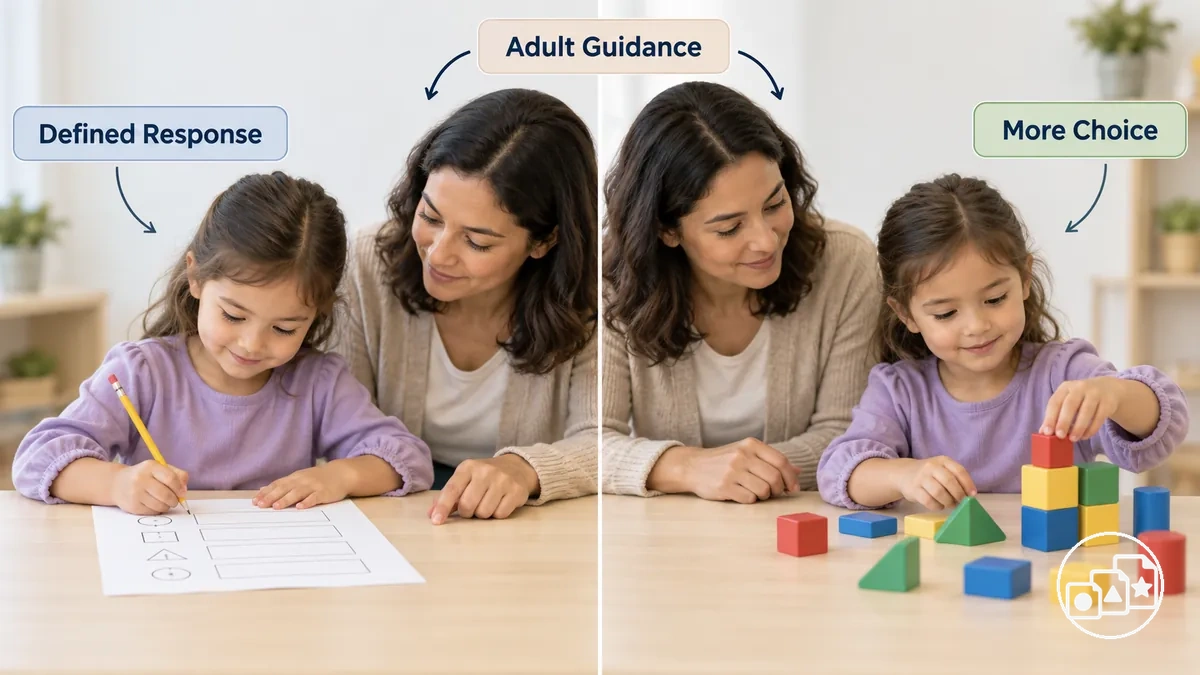
Task structure changes child participation by shaping who sets the instructions, which responses are available, and how much choice the child has.
Worksheet-based practice often constrains response freedom through a defined task format, while still allowing choice when the activity is designed that way.
A hands-on task can permit more physical manipulation and child choice, although instructions and adult direction may still guide the activity.
Approach
Response Structure
Child Choice and Manipulation
Adult Role
Participation Implication
Worksheet-based practice
Instructions commonly define the task and expected response format.
Response freedom may be narrower, although task design can include choices.
Adults can explain instructions, guide pace, or respond when support is needed.
The child mainly participates by selecting, marking, drawing, matching, or recording responses within the task format.
Hands-on activity
Instructions can define a goal while permitting different actions or response paths.
Physical manipulation can provide more ways to handle materials and make choices.
Adults can set boundaries, demonstrate actions, ask questions, or allow greater child direction.
The child may participate through manipulating materials, choosing actions, and adjusting responses within the activity's constraints.
Pace and adult direction can change how much control the child has within either task format.
Greater guidance can narrow available choices, while flexible pacing can permit more child-directed responding within established instructions.
Neither format fixes the level of autonomy because task structure, guidance, and available choices vary by design.
Repetition, Feedback and Visible Evidence of Practice
Practice evidence shows how repetition and feedback occur, but it does not automatically establish understanding.
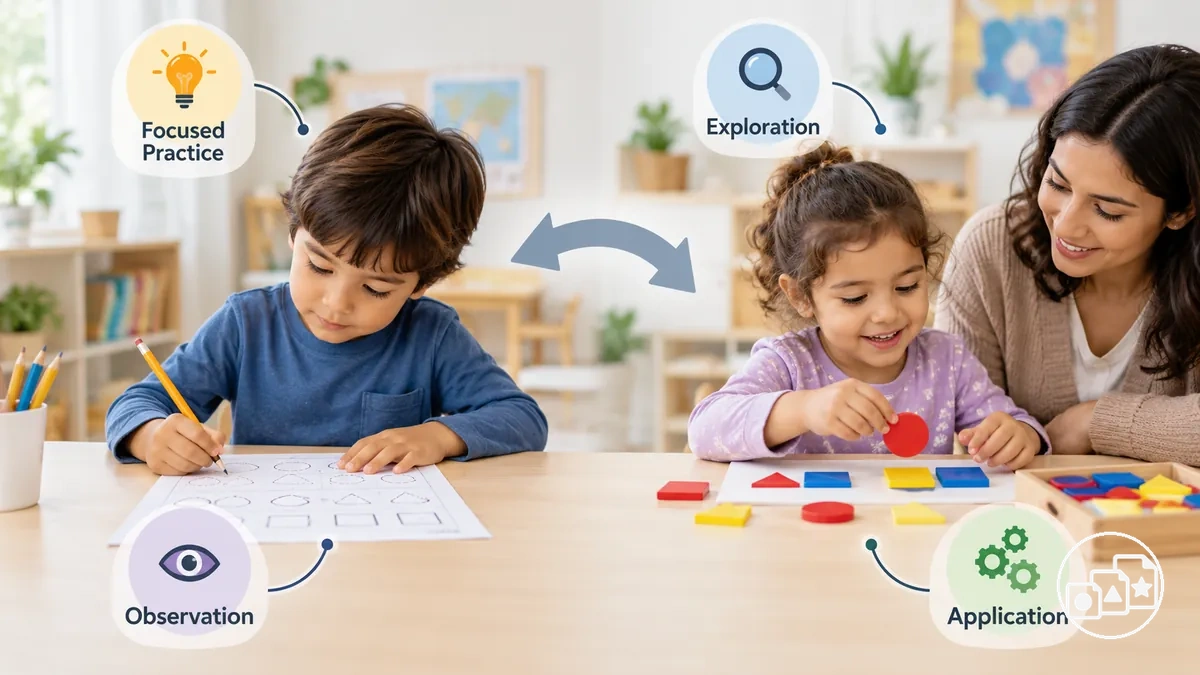
Worksheet-based practice can provide repetition through repeated items, with worksheet completion recording the child's responses and adult correction guiding a later attempt.
Hands-on practice can repeat an action or manipulation, while observation allows an adult to give feedback as the activity develops.
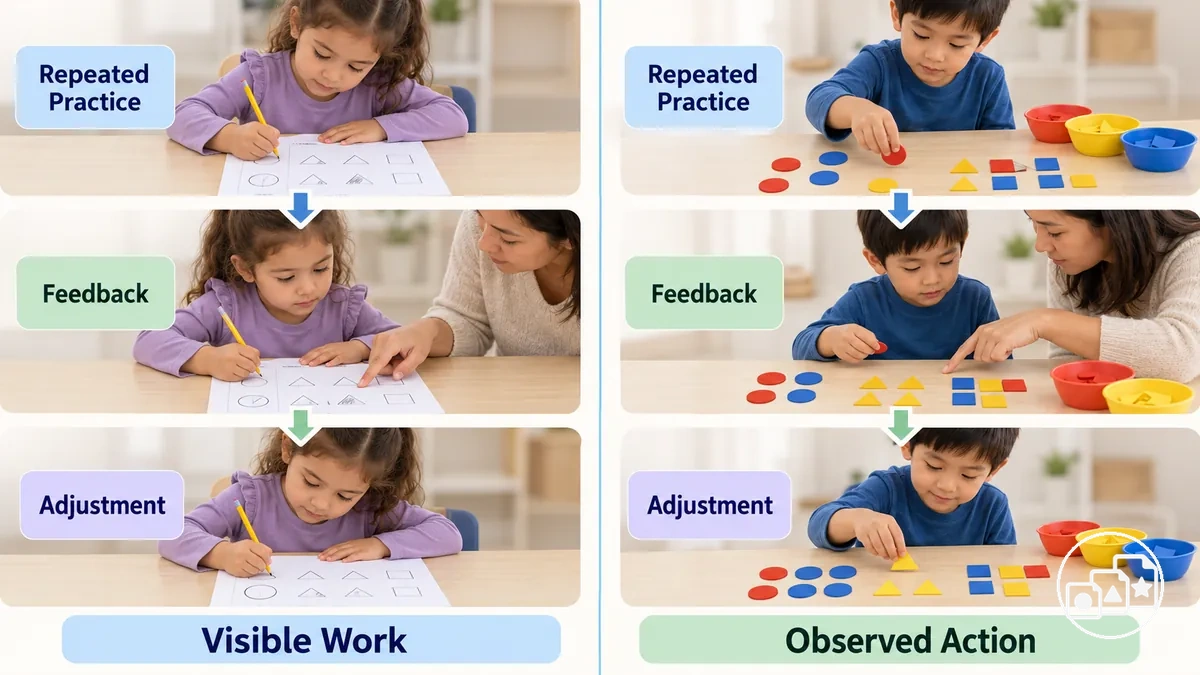
The image compares how repeated practice, feedback, and adjustment become visible through worksheet output and observed hands-on performance.
The following dimensions separate practice mechanics from evidence interpretation by distinguishing repetition, feedback, observable evidence, and adjustment.
Repetition: Repeated items make successive worksheet responses visible, while hands-on practice can repeat sorting, matching, arranging, or other actions.
Feedback: Adult correction can identify a worksheet response to reconsider, while observation can inform feedback during a hands-on attempt.
Observable evidence: Worksheet completion creates visible work showing task performance; observation may reveal the actions or strategies used during hands-on performance.
Adjustment: Feedback can inform the next response or action, allowing adjustment during a later item or another hands-on attempt.
Visible work and observed performance provide different evidence about what the child did during practice.
Interpretation depends on the task and observation context because either form of evidence may capture only part of the child's performance.
Worksheet completion or an observed action does not necessarily demonstrate understanding or application beyond that activity.
Evidence of practice is not the same as evidence of mastery.
Active Exploration, Play and Skill Application
Hands-on learning can support skill application when active manipulation, exploration, or contextual action directly serves the learning goal.
What makes the activity purposeful
Purposeful interaction
Manipulation, movement, experimentation or choice contributes to learning when the child must use the target concept rather than simply stay physically active.
Hands-on is not automatically play-based
A hands-on task may be adult-guided and goal-directed even when the child physically manipulates materials.
Play-based overlap
Play-based learning can add child choice and exploration while guidance keeps the activity connected to a specific learning purpose.
Example: classification through changing rules
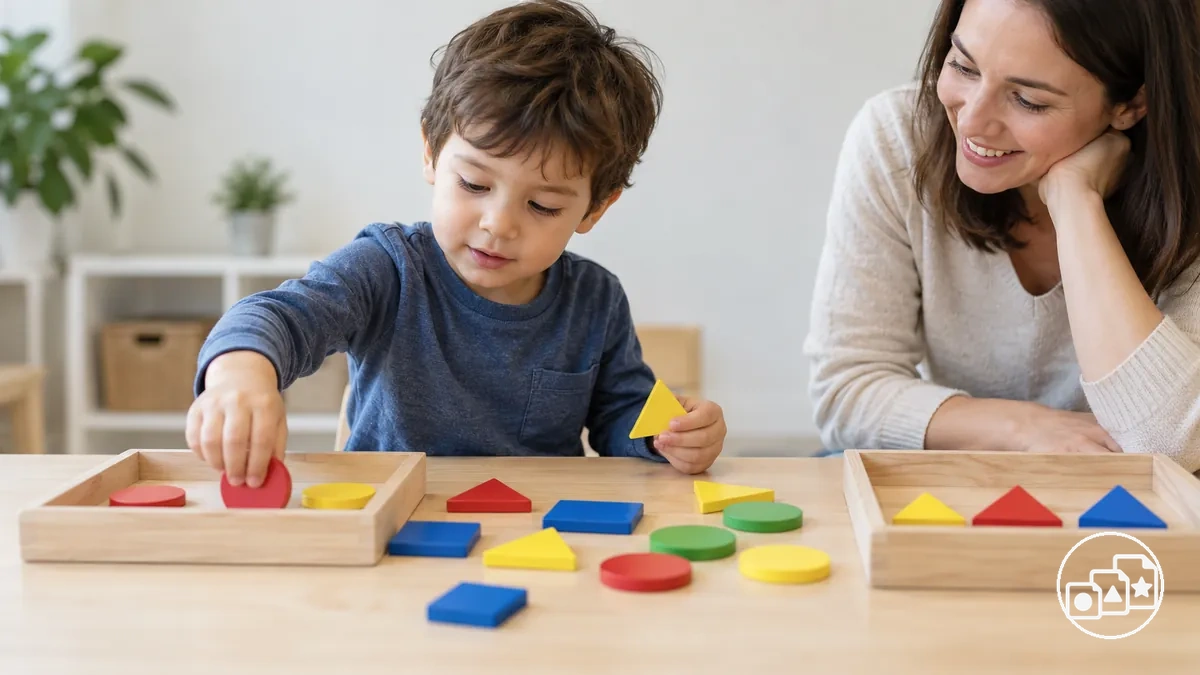
Ask the child to sort objects by shape, then change the rule and sort the same objects by another relevant attribute. The child must apply the classification idea through active manipulation and adjustment, not merely move the materials.
The concrete experience is useful when the interaction remains aligned with the intended learning goal.
Benefits and Limits of Worksheets and Hands-On Learning
Worksheets and hands-on learning involve trade-offs rather than fixed advantages and disadvantages.
A feature can be useful under one learning condition and limiting under another, depending on the learning goal and task design.
Their benefits and limits are therefore best compared through the same evaluation dimensions rather than treated as a universal preference.
Key trade-offs at a glance
Focused practice and exploration
Worksheets can support repetition and clear responses; hands-on learning can support purposeful manipulation and exploration. Either is useful only when the feature serves the target skill.
Observability
Worksheets create visible recorded work, while hands-on tasks can expose actions, choices and strategies for observation.
Transfer
Transfer depends on reapplying the target skill in an appropriate context, not on the activity format alone.
Motor and attention demands
Writing, marking, handling materials, movement or sustained attention can reduce fit when those demands become harder than the skill being practised.
Adult support
Support can clarify instructions, provide feedback, model an action or guide exploration without changing the underlying learning goal.
Claims about engagement, transfer, or broader effectiveness need to remain within the task, population, and context represented by the evidence.
Results can vary with task design, adult support, learning conditions, and the children involved, so findings from one activity or group do not establish a universal advantage.
Benefits and Limits of Worksheet Practice
Worksheet practice can support focused repetition when the task matches the learning goal and the child can perform its response demands.
Its value depends on what is being practised and how the task is designed.
Focused repetition: Worksheet practice can provide repeated opportunities to practise a specific response, but repetition is useful only when the repeated task remains aligned with the target skill.
Response expectations: Clear response expectations can make the required action explicit, while a narrow response format may limit exploration when the learning goal requires manipulation, choice, or multiple ways to respond.
Visible task output: Paper-and-pencil practice creates visible task output that shows what the child recorded or completed, but completion does not necessarily show understanding.
Motor demands: Writing, drawing, tracing, or marking responses may support paper-and-pencil practice, but motor demands can overshadow the target skill when producing the response is the harder part of the task.
Attention demands: A defined paper-based task can focus attention on a specific activity, while attention demands may limit usefulness when maintaining focus becomes more difficult than practising the target skill.
Transfer: Worksheet practice may support transfer when the practised response connects with the learning goal and meaningful application, but transfer may be limited when practice remains isolated from another relevant context.
Worksheet-based practice can provide clear response expectations, focused repetition, and visible task output when those features support the intended skill.
Paper-and-pencil practice also creates visible work that an adult can review, although completion shows task performance rather than necessarily showing understanding.
Its usefulness can therefore decrease when the response format or task demands compete with the skill being practised.
Motor demands or attention demands may overshadow the target skill when producing or sustaining the required response becomes the more demanding part of the task.
Persistent refusal, rushing, or loss of focus is a signal to examine task fit and support rather than proof that worksheet practice is categorically unsuitable.
Persistent worksheet engagement problems require separate troubleshooting rather than diagnosis within this comparison.
Benefits and Limits of Hands-On Learning
Hands-on learning can support exploration, manipulation, problem-solving, and contextual application when the activity serves a clear learning goal.
Its value comes from purposeful participation rather than activity level alone.
Manipulation and contextual application: Handling materials allows a child to apply a target concept through concrete actions, but the manipulation needs to remain connected to the intended learning goal.
Exploration and problem-solving: Exploration may encourage curiosity, experimentation, and problem-solving when choices require the child to use the target skill; open-ended activity without a clear purpose may not provide the intended practice.
Fine-motor activity: Handling, arranging, sorting, or moving materials can include fine-motor activity, although those physical demands may compete with the target skill when manipulation becomes the main challenge.
Social interaction: A hands-on activity can include social interaction when children or adults share materials, choices, or responses, but its relevance depends on whether that interaction supports the learning goal.
Observation: Hands-on participation can make actions, choices, and strategies available for observation, while differences in adult observation or task conditions can make performance harder to interpret consistently.
Setup and task consistency: Materials and physical participation create setup demands, and inconsistent tasks can make performance across attempts difficult to compare because the conditions have changed.
These features are most useful when task design keeps manipulation, exploration, and participation connected to a specific learning purpose.
For example, sorting objects becomes a clearer contextual application when the child sorts by an identified attribute rather than simply moving the materials.
Adult support can clarify the learning goal while leaving room for experimentation and choice.
Hands-on learning may be limited when the learning goal is unclear, setup demands interfere with practical use, or changing materials and instructions reduce task consistency.
Observation can also vary with the adult, activity, and context, so visible participation does not by itself establish what the child understands.
Greater activity is not evidence of greater learning unless the activity requires application of the intended skill.
Choosing Between Worksheets and Hands-On Activities by Learning Goal
The learning goal should determine whether worksheet practice, a hands-on activity, or combined use is the better fit.
The primary decision criterion is what the child must do to demonstrate the target skill.
A discrete response or symbolic recording may favour paper-based practice, while physical manipulation, real-world application, or observation of strategy may favour hands-on activity or combined use.
The criteria below map each learning goal condition to its likely format fit rather than ranking the approaches.
Each condition changes the implication according to whether the goal requires repetition, manipulation, observation, recording, or transfer.
Learning Goal Condition
Worksheet Fit
Hands-On Fit
Combined Use Implication
Discrete repeated response
Fits when the learning goal requires repeated practice of a clearly defined response.
Fits when the same response needs to be demonstrated through concrete action or materials.
Can combine concrete practice with repeated paper-based responses when both forms serve the same learning goal.
Physical manipulation
May record or represent the result, but does not provide the physical manipulation itself.
Is more suitable when handling, arranging, sorting, or moving materials is part of demonstrating the skill.
Can combine physical manipulation with later symbolic recording of the action or result.
Observation of strategy
Can show a recorded answer or visible work, but may provide limited evidence of how the child reached it.
Favours observation when the child's actions, choices, or adjustments are relevant to the learning goal.
Can combine observation of strategy with a recorded response when both process and output matter.
Symbolic recording
Fits when the learning goal requires the child to mark, draw, match, trace, or otherwise record a response.
May support the concept through concrete experience when symbolic recording is not the only required performance.
Can connect concrete experience with subsequent symbolic recording when the learning goal requires both forms.
Real-world application and transfer
Can provide a representation of the target skill, but transfer requires the skill to be reapplied beyond the paper-based task.
Fits when the learning goal requires real-world application in a relevant context or with concrete materials.
Can combine initial practice or recording with reapplication in another context when transfer is part of the learning goal.
Readiness, motor requirements, attention requirements, and other task demands can modify the fit indicated by a decision criterion without replacing the learning goal as the primary frame.
Questions about developmental fit and when worksheets are appropriate require separate consideration rather than an age-based decision within this framework.
The same child may therefore use different formats for different learning goals because the required response, context, and task demand can change.
Learning Goals That Suit Focused Paper-and-Pencil Practice
Focused paper-and-pencil practice can suit learning goals that require recognition, matching, simple marking, tracing, recording, or repeated retrieval through brief, explicit responses.
The child needs to understand what the task requires so that the paper response represents the target skill rather than confusion about the format.
Suitability decreases when the response demand or motor demand overshadows the target skill.
Recognition: A recognition goal can suit paper-based practice when the child can indicate a known item through a simple explicit response, such as selecting or marking it.
Matching: Matching can suit worksheet practice when the goal is to identify a relationship between presented items and the required response remains simple enough to show that relationship.
Simple marking: Circling, ticking, or making another simple mark can represent a choice when producing the mark does not become more demanding than identifying the intended response.
Repeated retrieval: Repeated retrieval can use a series of explicit responses when the child already understands the task and each response requires recalling or identifying the target information rather than learning the response format.
Tracing and recording: Controlled tracing or symbolic recording can fit when producing the written or drawn response is relevant to the learning goal and the motor demand does not obscure the target skill.
Motor-demand boundary: Paper-and-pencil practice may interfere when tracing, drawing, or recording requires more effort than the target skill itself, because the visible response may then reflect motor demand as well as the intended skill.
These criteria keep the response requirement tied to the learning goal rather than to the worksheet label alone.
For example, matching a pictured object to its corresponding shape can fit focused paper-and-pencil practice when the goal is recognition of the relationship and the child can make the required mark without that action obscuring the recognition task.
Richer exploration may be needed when physical manipulation or contextual transfer is central to demonstrating the target skill.
Learning Goals That Suit Exploration and Active Application
Exploration and active application can suit a learning goal that requires manipulation, experimentation, sequencing actions, social language, or real-world application.
These goals benefit from physical interaction or contextual use when the target skill must be demonstrated through what the child does, tests, says, or applies rather than only through a constrained symbolic response.
Physical activity alone is not the criterion; the interaction needs to be part of showing understanding through action or applying the target skill.
Manipulation: A learning goal involving objects or quantities is more suitable for active application when handling, arranging, combining, or comparing materials is part of demonstrating the target relationship.
Experimentation: Testing ideas benefits from physical interaction when the child needs to try an action, observe what happens, and adjust the next action in response.
Sequencing actions: A goal involving a procedure or ordered process requires active application when understanding is shown by carrying out actions in the relevant sequence rather than only identifying their order symbolically.
Social language: A social-language goal requires interaction when the target skill involves using language with another person in context, such as responding, requesting, explaining, or taking conversational turns.
Real-world application: A goal involving contextual use benefits from active application when the child needs to apply a concept within a relevant situation rather than only recognise or record it.
Showing understanding through action: An action-based demonstration is more suitable when the learning goal is revealed by how the child uses materials, choices, language, or a sequence of actions and a marked answer would capture only part of that performance.
These criteria connect the learning goal to the interaction needed to reveal or apply the target skill rather than treating movement itself as evidence of understanding.
For example, if the learning goal is to compare quantities through manipulation, physically arranging two groups makes the comparison part of the demonstrated action instead of reducing the task to marking a preselected answer.
Symbolic practice may still follow active application when recording or reapplying the concept is also relevant to the learning goal.
Balancing Worksheets with Hands-On and Play-Based Learning
Balance should follow the learning goal and task conditions rather than a fixed ratio between worksheets, hands-on activity, and play-based learning.
Readiness and task demand help determine whether the child needs more concrete experience, focused practice, or an opportunity for reapplication.
The emphasis may shift with engagement and observation because the most useful format depends on what the child needs to understand, practise, or apply.
Learning goal: Combine approaches according to what the child needs to demonstrate, keeping exploration, symbolic practice, and contextual use connected to the same learning goal.
Readiness and task demand: Adjust the balance when the response or activity demands compete with the target skill; observation of engagement and performance can indicate when the current format is no longer a good fit.
Concrete experience: Use hands-on activity or purposeful play-based learning when manipulation, exploration, or choice helps make the target concept available through concrete experience.
Focused practice: Add paper-based focused practice when an explicit response, repetition, or symbolic practice supports the learning goal without the worksheet demand obscuring the target skill.
Reapplication: Return to active or contextual use when the child needs to apply the skill beyond the practice format, using observation to adjust the next opportunity when necessary.
Example pattern: comparing quantities
Explore: arrange or compare two groups of objects through manipulation.
Record or repeat: use a brief worksheet when symbolic recording or repeated comparison supports the same learning goal.
Reapply: compare quantities again while choosing or arranging objects in another relevant context.
This is an adaptable pattern, not a mandatory sequence; the order or emphasis may shift with readiness, task demand, engagement or the learning goal.
To move from these general principles to practical home planning, parents can plan worksheet practice at home according to their own learning context.