
When Worksheets Are Appropriate Before Kindergarten
Worksheets can be appropriate before kindergarten when the child can manage the task’s motor and thinking demands, the worksheet reinforces a familiar skill for a clear and limited purpose, and it supplements play and other active learning. There is no fixed starting age; judge fit from the child’s repeated response to the specific task rather than from age or one completed worksheet alone.
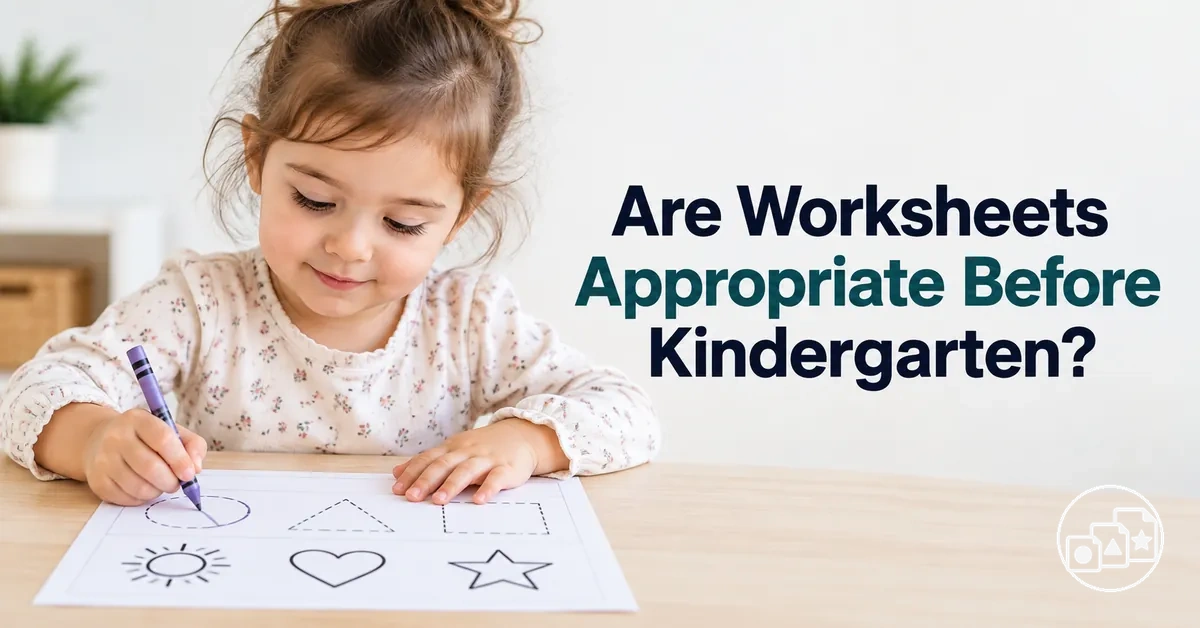
At a glance
Is this worksheet a good fit right now?
Use all four checks together. They evaluate the fit between the child, the task and the learning context; none is a stand-alone age test.
- 1. Task demands
- The child can understand the instruction and any symbols involved, and can manage any required mark-making or tracing without the mechanics becoming the main barrier.
- 2. Prior familiarity
- The skill or concept is already familiar from earlier experience, so the page is being used for practice rather than first-time teaching.
- 3. Learning purpose
- The purpose is narrow and clear: reinforce a specific familiar skill, not prove overall kindergarten readiness or broader understanding.
- 4. Learning context
- The worksheet supplements play, conversation, movement, object manipulation and real-world experience instead of routinely replacing them.
Closer fit: the four conditions align and the child can engage with the task as intended.
Mismatch: simplify or change the task, return to more concrete experience, or pause that worksheet when the same mismatch persists.
The sections below explain how to judge each part of that fit and how to interpret worksheet performance without treating it as a complete measure of readiness.
Table of Contents
What Makes Worksheet Use Developmentally Appropriate Before Kindergarten

Suitability can be judged by looking for an observable fit or mismatch between the worksheet demands and the child's response in that use context.
A child who can engage with the task as intended shows a closer task fit, while persistent difficulty engaging with what the worksheet requires may indicate that its demands are poorly matched to the child's current abilities.
The National Association for the Education of Young Children describes developmentally appropriate practice as strengths-based and play-based, with teaching decisions informed by children's development, individuality, and context.
No single dimension determines suitability on its own. Current abilities, worksheet demands, learning purpose, and use context need to be considered together.
The Child Can Manage the Required Fine-Motor and Thinking Demands
A worksheet is better matched when the child can manage both the physical and thinking demands of the specific task.

Fine-motor demand
Attribute: physical control of the writing tool.
Examples: holding and guiding a pencil or crayon for mark-making or tracing.
Possible mismatch: the child understands the goal but tool control is the main obstacle.
Thinking or symbolic demand
Attribute: understanding what the task represents and asks.
Examples: matching familiar symbols, recognising task meaning or following a simple instruction.
Possible mismatch: the child can handle the tool but does not yet understand the task.
Interpretation: difficulty in either area describes the fit of this task to the child’s current capabilities; it does not by itself establish broad worksheet readiness.
Cleveland Clinic identifies holding a pencil and writing or drawing as examples of fine-motor skills, supporting the distinction between physical tool control and the separate thinking demands of a worksheet.
The Worksheet Reinforces a Familiar Skill With a Clear, Limited Purpose
A worksheet is a better fit when its learning purpose is to reinforce a familiar skill the child has already encountered through prior experience.

- Encounter the idea first
The child meets the skill or concept through prior experience, such as recognising a shape or a known symbol.
- Use the worksheet for rehearsal
Tracing a familiar shape or matching known symbols gives targeted practice of something already introduced.
- Interpret completion narrowly
Finishing the task shows performance on that activity; it does not by itself establish conceptual understanding or broader readiness.
Worksheet Use Supplements Rather Than Replaces Active Learning
Worksheet use is better treated as a supplement to active learning rather than a replacement for it.

Worksheet as a supplement
The child explores the idea through play, movement, conversation, real objects or other hands-on experience, then uses a short paper task to rehearse one part of that learning.
Example: sort physical objects by shape, then match the same familiar shapes on paper.
Worksheet as a replacement
The worksheet becomes the child’s only encounter with the activity and repeatedly displaces interaction, manipulation, movement or conversation that carry broader learning value.
This distinction concerns role and sequence rather than a universal winner. A broader comparison of worksheets versus hands-on learning considers the strengths and limits of each learning format.
Readiness Matters More Than a Fixed Starting Age for Worksheets
Chronological age can inform expectations for worksheet use before kindergarten, but it does not determine whether a preschooler is ready for a particular task.

- Chronological age
- Context, not a universal threshold. Children of the same age can differ in the abilities a particular worksheet requires.
- Task fit
- Primary decision basis. The worksheet is a closer fit when its complexity matches current capabilities and the child can engage meaningfully with it.
- One worksheet result
- Narrow evidence only. An easy or difficult attempt does not establish general developmental readiness; changing the task can change the fit.
For example, two preschoolers of a similar age may encounter the same worksheet differently: one may comfortably understand and engage with a simple matching task, while the other may find its task demands difficult to manage.
Once that suitability has been considered, using worksheets at home is a separate practical-use context.
When Worksheets Are Not Appropriate for Preschoolers
Worksheet use is poorly matched when the task demands exceed a preschooler's current abilities, the format overshadows the learning goal, or worksheets repeatedly replace more suitable interactive learning experiences.
These conditions describe a worksheet-task mismatch rather than a diagnosis of the child.
Look for repeated mismatch, not one imperfect attempt. These signs matter most when they persist in the relevant learning context.
- Task demands exceed current abilities: persistent difficulty managing what the worksheet physically or symbolically requires may indicate that the task is poorly matched at that time.
- Repeated frustration or disengagement: a recurring pattern of frustration, withdrawal, or disengagement during the task may indicate that the worksheet format or task demands are interfering with the learning goal.
- Abstract task without prior concrete experience: difficulty with an abstract task may indicate poor task fit when the preschooler has not yet encountered the idea through concrete experience or prior familiarity.
- Worksheets routinely replace interactive learning: when worksheet use repeatedly substitutes for play, conversation, movement, manipulation, or other interactive experience, the format can become poorly matched to the broader learning goal.
How Worksheets Can Support Kindergarten Readiness
Worksheets can support a limited part of kindergarten readiness when targeted practice reinforces familiar skills that a child has already encountered.
That contribution depends on prior experience and task fit rather than worksheet completion alone.
Can support
Targeted rehearsal of familiar, paper-suited skills such as shape matching, tracing or recognising previously introduced symbols when the task fits the child’s prior experience.
Cannot establish by itself
Whole-child kindergarten readiness, broader language or mathematical understanding, self-regulation, social capability or practical readiness from worksheet completion alone.
Within the broader kindergarten readiness worksheets context, targeted worksheet practice is one possible learning activity rather than a complete readiness method.
Broader readiness also develops through communication, self-regulation, movement, play, and participation in everyday activities.
Worksheets Can Reinforce Specific Skills Without Representing the Whole of School Readiness
A completed worksheet can show performance on a specific paper task, but it cannot by itself establish kindergarten readiness as a whole.
Read each result narrowly: task performance is not a whole-readiness verdict.
- Letter recognition: identifying or matching a familiar letter can show practice with recognising that letter, but it does not establish broader language ability.
- Number recognition: identifying or matching a familiar numeral can show practice with recognising that numeral, but it does not establish broader mathematical understanding.
- Matching: pairing familiar pictures, shapes, or symbols can show practice with the specific relationship presented in the worksheet activity, but it does not establish how the child applies that relationship in other contexts.
- Tracing: following a familiar line, shape, letter, or numeral can show practice with that tracing task, but completion alone does not establish broader readiness.
- Mark-making: making a requested mark on a paper task can show practice with that specific action, but it does not establish broader practical or communication capabilities.